Showing posts with label National Library of Australia. Show all posts

Thursday, 4 September 2025

Picture Us

During its 15th birthday celebrations last year, there were numerous comments about the essentiality of Trove for social and historical research in Australia. 

One comment included a brief statement acknowledging the 25th birthday of the service which started the National Library of Australia's journey into making digital content accessible to everyone via the world wide web.  

So that means Picture Australia would be 25! Congratulations, hard to remember what we did before you.

            - F.S. 4 December 2024 

It is very gratifying to know that our work made such a difference to the working lives of colleagues and, by extension, to the public.  

Today marks 25 years since the launch of PictureAustralia. 

PictureAustralia was written in the naming trend of web services in the early 21st century.  It was officially launched on 4th September 2000. A prototype called ImageSearch made its debut at the Online On Disc conference in Sydney the year before.  

It was an experiment for the National Library, which trialled new web-enabled search engine software, browser design to maximise interrogation, and behind-the-scenes interactions with library "catalogues" hosted elsewhere that displayed the content in real time. Its simple technical architecture inspired other libraries, archives and museums to join in. 

PictureAustralia enjoyed several interface design iterations, including this one. 


The service had been well promoted with a series of items to be shared with the public. The PictureAustralia logo loaned itself to many formats, although a postage stamp was eventually vetoed.


bookmark

flyer


tattoo


The service was marketed nationally through a very large range of postcards. Its scope had broadened after five years, as evidenced by this postcard image from participant The City of Sydney Archives found at the Elephant Rock cafe in Currumbin, Queensland. 

Robyn Bracken, Archaeology of Bathing.
webarchive.nla.gov.au/awa/20091021195941/http://www.cityofsydney.nsw.gov.au/history/waterexhibition/images/zoom/archaeology.jpg.html

Both the National Library of New Zealand and Libraries & Archives Canada were keen to emulate the service; NLNZ joining in and LAC introducing Images Canada.

Picture Australia was switched off in 2012. The records linking to a myriad of Australian collections of images were added to Trove, and made available in the Photos zone... the ethos of one simple search across many sources of heritage content was carried over too. 

Acknowledgements: CL & DF, JF & WSC, TB & DL, FH and Lady N


The Australian, 29 August 2000, p.41


Sunday, 12 August 2018

down to earth

The building which houses the National Library of Australia commemorates 50 years today, although the mission was established as part of the 1901 Constitution. It's an inverted iceberg, with more storeys above ground than below. 

I worked in the building for more than half of its life, a milestone which will cease in five years' time. It wasn't and isn't uncommon for staff to exhibit this loyalty, not just because the place represented a career pinnacle, but because it underpinned commitment to the belief that the National Library, like all other libraries, was an essential service to the public. I remember making the decision 10 years in, when asked by a more senior colleague, "are you a stayer?" after a large project failed. By that time the Library and I had invested significantly in each other, so I stayed.

The original concept drawings showed the possibility of three separate buildings, later reduced to one to save money. That was enough in the early years, but with a relentlessly growing collection, the Library is now utilising a third warehouse. Another construction cost-saving measure ensured that staff and researchers focus inwards - each long side was reduced by one column, effectively blocking the view from every window except for a narrow sliver.

My first visit there was as a university student in the late 1970s when the Main Reading Room on the ground floor was a very quiet place for contemplation, unlike the keyboard-punctuated silences now. 

When the building caught fire in 1985, bibliophiles and historians around the country looked towards Canberra in horror. They included a prospective Director-General, the late Warren Horton, who felt compelled to move interstate to assist in the Library's recovery.

The fire started on the fourth floor in the computer room. More damage was caused by water from fire hoses than actual burning, and when I started work at the Library the year following, thousands of books were still laid out on metal shelves along the long third floor lakeside corridor drying. This continued for several years. The computer mainframe which supported the national catalogue and bibliographic network was moved to a specially sealed room in the middle of the second floor, with collections further away. 

IT staff sat outside the computer room, in an area where air-conditioning controls had been set for the preservation of books. We were often plunged into extremes of preservation-friendly temperatures. For a while, the smaller programming team sat in the Amazon Room, named after a film poster on the wall showing "Amazonian" women. 

All of the windows in the Library were able to be opened with an allen key, and this proved useful when a large piece of mainframe had to be removed from the second floor through the Amazon Room. It was more efficient than trying to squeeze it around corridors. The scratch on the beautifully-veined marble lintel did cause some consternation. 

Some 10 years later, the windows in the fourth floor conference room had to be opened when a water pipe was broken in the ceiling and flooded the carpets at the front of the building. The hosepipes were thrown out to ground level. 

Ironically, contrary to expectation, almost all water damage seems to have come from within the building, fortunately infrequently. After three successive droughts in the early 2000s, the floor to ceiling windows next to the front door cracked - the result of a complete lack of moisture in the air. By that time, the glass airlock which surrounded the front doors had been removed - its double-sliding, painstakingly slow opening no longer necessary.

Before earning a job at the Library, in the early days of my genealogical passion I had to visit the first floor Petherick Reading Room, named for one of the Library's significant collection donors. It was sited in the middle of the building and closed off in its beautifully-panelled, glass-fronted and book-lined shelves to serious researchers using rare materials. The Room was moved to the ground floor, and a few years ago moved back to the first floor again. 

Eventually reference volumes made their way to LG (Lower Ground) 1, where they shared a space with newspapers from around the country. Despite being below ground, the light-filled lower Reading Room gave a generous view of the inside of the moat. 
Pippa and Dee fly handmade kites outside the National Library's moat, 18 July 2001
The Library sits on its own island. Now appreciated by amateur rockwall climbers, the moat was built to protect the collections from the one-in-100 year Molonglo River flood. Although that flood has not happened yet, the River has combined with occasional downpours to fill Lake Burley Griffin with dead trees.

A lot of paper rests behind the very effective moat, especially Australian monographs and journals. While most project records were stored electronically, some were kept on paper just in case. In 1997 I stood looking at the cold bare earth, beneath the LG2 floor, while filing the records. 

As projects finished I moved to other spaces, working on the first, second, third, and fourth floors. During downtimes, I enjoyed the rare privilege of browsing the bookshelves and cabinets below ground. The office I retired from was moved from the long side facing Parliament House to the lakeside. The floorspace has been given over to the collection. Much architectural change occurs on the inside, often hidden from the public, but the responsibility at the heart of this public-facing collecting institution is immutable.

Saturday, 31 March 2018

A service to the public

CCAE pin

CCAE newsletter, 1979
Even before finishing the Graduate Diploma in Computing Studies, I received a job offer from the Commonwealth Public Service to be a programmer. The Canberra College of Advanced Education (CCAE) had its own Burroughs B6700 mainframe, the same type of computer rented by the Department of Immigration & Ethnic Affairs (DIEA).
The Department’s A.D.P. (Automated Data Processing) Section sent representatives to the College to persuade graduands to become new recruits, an experience quite different from the university graduate examination imposed by the Public Service Board. 
The CCAE had a good relationship with the Public Service, and performed its employment feeder role well. Although my first experience with a mainframe was using the Univac at the Australian National University in 1978 to count results from a psychology survey, the requirement to fill mark-sense cards with precise black felt strokes and leave them for an overnight processing run seemed like magic rather than a deterrent.
So the CCAE's Graduate Diploma beckoned, and with a good balance of male and female IT  experts, we were soon immersed in dot matrix printouts, restricted mainframe time (the most expensive resource) and a wide range of subjects from coding in standard languages like COBOL, Assembler, Pascal and Fortran to systems and business analysis.
The first coding skill I took to my new workplace was in the Job Control Langage – JCL - operating instructions used to start and finish tasks. 
The CCAE’s School of Information Sciences discharged its educational responsibilities assiduously. This was the introduction to Programming Systems 1, Semester 1, 1981:

“While this course teaches computer programming using two different languages, its central theme is that of “structured programming”; this theme is the common thread running through the course irrespective of which language is being taught. Right at the outset we wish to make clear that programming must not be confused with merely writing code.”
The use of computing resources was under strict control, as was access to commercial system documentation.
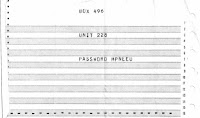
The extended availability of machine time in the nighttime hours, rather than during the day, soon led to midnight sessions. Coding a trip instruction for an endless processing loop was always a consideration - a few hapless students didn’t and lost their entire processing allocation for 24 hours which jeopardised their assignment submissions.


The School of Information Services’ staff were not without a sense of humour. Programming tasks included code for managing student numbers and rankings, generating a ‘Merry Christmas’ banner, and conducting a full analysis of the Department of Overseas Aid’s (DOA) operations prior to coding a new application for it. 


DIEA had responsibility for Australia's arrival and departure Passenger Card Index, a huge database which was backed up on 26 magnetic tapes. 
My midnight learning sessions turned into weekend sessions as I oversaw the data updates each weekend on a Burroughs B6700 rented from the Department of Administrative Services at Fyshwick (in Canberra). 
Despite its significant responsibility, the A.D.P. section had almost a skeleton staff. There was very little emphasis on teamwork - each programmer had a primary responsibility that absorbed all the time available.
By the mid 1980s, DIEA was given the budget to purchase its own mainframe, which meant the ADP group had to grow. Wanting to stay in a small IT shop, I transferred to the National Library of Australia’s A.D.P. Branch in early 1986. 
The Library was five years into hosting a union catalogue system called the Australian Bibliographic Network. The underlying database was coded in PL/I, a coding language similar to COBOL, and the reliance on it by all of the nation's libraries imbued the service with an indispensability on a scale not matched at that time by the number of immigration offices needing access to passenger cards.
8 May 1981
Two other programmers already maintaining this service were CCAE School of Information Science graduates in the same year as me. The National Library's working environment had another characteristic which had been well taught - the value of teamwork. 
Even as I moved from the roles of programmer to project manager to inaugural business manager for the award-winning Trove, the National Library's innovative 21st century platform for information discovery and engagement, the approach never changed.
Trove's first four years were my last four in the Australian Public Service. (Coincidentally, 1968 celebrates 50 years of the building of the National Library as well as the Canberra College of Advanced Education.)
Although we now operate in a web interface- and mobile device-enabled environment for accessing information, the basic principles of programming practice then were still the same as now: garbage in, garbage out; the importance of rigorous documentation; and the value of teamwork in scoping and designing solutions to improve human-computer interaction. The CCAE deserves recognition for the professional grounding it provided to public servants and in particular for its Information Scientists including Kate O’Driscoll, Igor Hawryszkiewycz and Bill Ginn. 

Acknowledgement

This story was originally compiled for the University of Canberra's Personal Histories Project


Tuesday, 16 August 2016

How to be beguiled by a library

Sometimes a story lies hidden, just waiting for discovery. How fortunate we are to be able to solve a mystery in real time, when we start chasing such a story of a life lived publicly, albeit more than a century ago. A Terranora pioneer, Frederic John Davey, moved from Cornwall via Auckland to the Tweed River in the 1870s in an attempt to improve his health.

He was well-known on the Tweed as an architect, a photographer, a farmer, a Justice of the Peace, woodcarver hobbyist and a family man. Trove shares many digitised newspaper articles detailing his life, providing a rich context for research. It should have been no surprise then that one of his obituaries mentioned a previously unknown skill - writer, of both short stories and poetry.

Davey's architectural, photographic, and woodcarving activities were documented by the Tweed Heads Historical Society. Finding his writing proved more difficult, because his obituary* suggested that he wrote for English journals. The intriguing title of the series "Tales from the Wimbriatta" should have made the stories conspicuous in a full-text search, but Trove only revealed a duplicated obituary** (replicated from two other newspapers, now missing***). 


There was no mention of this place name elsewhere in Trove, which leaves an enticing mystery still to be solved. However, the journal title,Good Words, is mentioned. Was it necessary then to search with these two very common words? Trove arranges access to a large number of online journals in its Journals, articles, and datasets zone, and this journal is listed in both microform and digitised form. However, there is no way to search across the journal articles all at once. But an alternate pathway is at hand - a service established before Trove, also online, which can be activated with a little device available to all Australians - an individual National Library card.

Each Australian can arrange to have three - their local library card, their state or territory library card (SL), and their National Library (NL) card. They are needed to access fully digitised resources, known as eresources to encompass different databases hosted by separate publishers. Australian libraries arrange subscriptions to a subset of these databases for their communities, so while there may be some overlap in content, often there isn't. Through its access arrangements, the National Library links to many English journal offerings.

Davey home drawn by F J Davey, 1882
Once you have your NL or SL card, you can sign in and search using the word British to retrieve the British periodicals collection I and II. (Note that the first search will also list the nineteenth century digitised British newspapers collections.) Accept the licence conditions, and then follow the trail to a semi-autobiographical life as described in a home country journal, complete with posed photographs, by searching on the author's name: F J Davey. The photographs themselves are beguiling too - do they show Terranora Lakes where Davey was known to have built his home?

The actions which led to the availability of this journal online in real time reflect a true partnership of minds oriented towards community service, where the owner of the copy, the digitiser, and the reader sit on different continents. It's gratifying to know that decisions made many years ago by forward-thinking librarians in Australia and elsewhere allow us to assuage our curiosity now. 

* This obituary appeared in The Richmond River Herald & Northern Districts Advertiser.
** This obituary appeared in The Northern Star.
*** The Tweed Herald; The Tweed Times. Having complementary copies of such informative obituaries is a small miracle in its own right. F J Davey was such a high achiever that the obituaries appear in newspapers outside the area of his home town and surrounds. Trove illustrated its value yet again. 

Tuesday, 10 November 2015

Farewell to a gracious lady

Still-life with self-portrait
Viennese artist Judy Cassab died last week, on Tuesday 3 November. She was an extraordinarily generous person, a trait which shone through her art and her life in Australia. 

trove.nla.gov.au


Trove collates a lot of detail from a range of cultural heritage services about Ms Cassab's contribution to the country which adopted her, it is easy to find her story there. Not only snapshots of her work, but her thoughts are also captured for posterity in an interview from the National Library's collection, and as part of a joint initiative with the National Gallery

It is inspiring to hear the soft clear voice explaining the ineluctable force which motivated her painting. 

In 1999, the National Library decided to develop a new web service, which became known as PictureAustralia. An aggregation of the digitised images from art and photographic collections around Australia, PictureAustralia exemplified the value of collaboration nationally. Using simple web technologies, the creation of virtual galleries from physically separated collections became possible.

Internal discussions then ensued to decide how best to promote and raise awareness of the service. The National Library already held some of the works of Judy Cassab including portraits. It was important to illustrate the breadth of Australia's old and new collections, and Ms Cassab's contribution was an easy choice to feature. In addition, her generosity was already well known. 

So an approach to use her self-portrait as a postcard was made. The response was instant - "please go ahead and may I have several copies to send to friends?" The Library was only too happy to oblige, and this postcard was one of the reasons for the success which PictureAustralia became.


Sunday, 7 December 2014

"Not everything that can be counted counts,

and not everything that counts can be counted." [Einstein]

Statistics are bread-and-butter to politicians, and public servants spend a lot of time accumulating them. Many pages in Annual Reports of governments and businesses are devoted to the numbers illustrating that they are still worthy of investment. While they are not that straight-forward to find, they are always dutifully made available as part of accountability and transparency requirements, and frequently updated tallies are always a pleasure to report to keen constituencies. 

nla.gov.au/librariesaustralia
The Libraries Australia service hosted by the National Library has reported its growth, in a very similar format, for more than 30 years.

However, with the advent of Trove, a new approach was developed to put statistics directly into the hands of people contributing to the service.

 
http://trove.nla.gov.au


Statistics are often the last functional component of a new service to be developed, so this outcome was a breakthrough for public accountability. They are generated regularly, they are easy to locate and use, and they keep tabs on the exchange between Trove and an individual or an agency, especially useful for those maximising Trove for their own productivity.

However, this ease also seemed to mean that the statistics could be ignored by those who might derive some value from them. Parliament still prefers a one-size-fits-all model: number of visits to the website, 

www.nla.gov.au/sites/default/files/nla-annrep-2013-2014.pdf, p.43

not how a service might make a difference to the lives of Australians.

It was bemusing therefore to read the recent article by Jeff Kennett describing the importance of art: "People will always argue over any money spent on the arts, and insist it would have been better spent on education, health or some other service that already receives billions of dollars in annual recurrent expenditure. But I have always argued that you cannot have a cosmopolitan city without it having a strong cultural heart. That heart includes all forms of art, music, dance, theatre, architecture, sculpture and, importantly, colleges and places of learning." About the new art for Sydney, he went on to say "Sydney will be a better place for these three installations, and if they can encourage just one citizen to pursue an artistic career the sculptures will have done their job." Weekend Australian, August 2-3, 2014, p.8.

$million of dollars = three outstanding works of art = one citizen?

Is that a good return on investment? Do those statistics illustrate a difference has been made? Fortunately it isn't 'an economic measure'. While this expenditure on art is not begrudged at all, what about library services, created in Australia, which reach out to millions every day? Services which provide culture, heritage and learning to metropolitan, rural, regional, remote Australians equally, currently having their government funding reduced so that they need to seek dollars in other ways.
http://trove.nla.gov.au


This year, the government funded an Innovation Study of Australian Galleries, Libraries, Archives and Museums. It made only one mention of the increase in productivity encouraged by the heritage sector. [p.22] A lost opportunity?

Here's a self-measured statistic about Trove: "What five years ago was a month-long project at the State Library (if you could get a microfilm reader before everyone else) is now literally a five-minute exercise from home and an extra hour enables you to find and link information on a scale that could never previously have been imagined." Trove Evaluation Survey. [p.4]

Does it also measure:
  • proactive use of the NBN
  • reduced stress on transport infrastructure
  • saving of funds expended on depreciating government equipment
  • redirection of librarianship skills and resources to more meaningful work?
Trove has not yet reached its boundaries for growth. Make sure to keep using it, so its value continues to be counted as part of the rich heritage and productivity of the nation,
even if that value is only measured in the ever growing visits to the National Library's website. 

******** 


This entry marks the day 34 years ago when I became a full-time public servant, but I am no longer counting.


Saturday, 26 July 2014

Which flight path?

A recurring motif in my life has been the sense of connection expressed by a flight path. Unlike the iconic Australian movie, The Castle, the initial one I lived near for most of the first two decades of my life was relatively quiet. It is used by holidaymakers flying in and out of the airport with the codename OOL.

"Passenger flights took off for the first time in 1939 using the then grassy field of the current Coolangatta site. Regular services were started by Queensland Airlines and Butler Air Transport after the Second World War." [Ref: http://en.wikipedia.org/wiki/Coolangatta_Airport]


Originally known as Coolangatta airport, it changed its name in 1999 to the Gold Coast airport to stay as hip as the increasingly trendy surrounding areas. Luckily the distinctive codename was retained. Although my home at Cobaki bordered the New South Wales - Queensland dotted line, I didn't experience the runway until 1976, when I returned to my hometown on a first-year visit from university in Canberra.

Correctly flipped view, courtesy Peter Cokley
 

After several years of study at the Australian National University, and learning how to become a public servant at the Department of Immigration and Ethnic Affairs in the 1980s, I was invited to join other National Library staff as a computer programmer to look after the codebase which underpinned the Australian Bibliographic Network (now Libraries Australia).

One of the fabulous privileges of working in the Library's architecturally stunning building was the opening of the mezzanine level balcony for staff to watch celebratory fireworks every year. Sponsored by local radio station FM104.7, Skyfire is the locknote event celebrating Canberra's March birthday. The fireworks are placed in the middle of Lake Burley Griffin, and the natural backdrop of the hills surrounding the valley in which Canberra sits creates a spectacular cacophony of light and sound.

A few years ago, in an Airforce tribute as part of the fireworks, an F-111 was sent up from the Tuggeranong Valley south of the city. Thundering up Commonwealth Avenue and around the Library itself, in a flight path pointing towards Canberra airport, it seemed as though a wingtip would carve out a corner of the building. The echo of power was extraordinary, and it certainly dimmed the power of any antics inside.

Last year, to bookend a 27 and 1/2 year career at the National Library, I took a trip with my husband to Western Australia. Our goal was to traverse the Canning Stock Route, one of the most remote 4WD tracks in the world. It would be easy to succumb to a sense of isolation. Most water, all fuel and all food have to be carried along its 1,700 kms. There are many compensations though - the wildflowers changing every 100 kms and the beauty of the Albert Namatjira trees against a clear sky, day and night, were breathtaking.

When we reached Well 16, a quarter of the way into the wilderness, the sound of a jet overhead made us pause. It seems that the Darwin - Perth and Broome - Perth flights are also keen to see the scenery of the interior.

But the most spine-tingling flight path I have experienced was one I am sure I will revisit. In 2011 during a visit to Segesta in Sicilia, I made my way to the open-air teatro built more than 2,000 years ago by the Greeks.  The bare hills form an epic backdrop, the whole space still dramatic after all those years. I asked myself, what have we achieved in the 20th Century to match this? And at that very moment, an Italian fighter jet swooped in a circle around the site, on its way to Libya.